Supportive information:
1. To understand the Sikh resistance, one needs to comprehend the Sikh character, which encompasses the Sikh philosophy, religion, mindset, and culture. This character was built by our ten spiritual teachers, the Sikh Gurus, using the raw material of unbiased, selfless service towards God’s creation, the righteousness of courage, morality in thought and action, and fortitude to reject injustice, however mighty the oppressor may seem.
These are not just hyperbolic terms, but please refer to previous articles for various factual examples in each of these categories.
With reference to the present topic, I would describe Sikh courage in balance with humility in these words: Sikhs can be kind to a tiger as God’s creation, but also know how to tame the beast, if necessary.
They are calm and wait till it’s absolutely necessary to accelerate counteraction. Please understand this in context with the tenth Guru’s words, as described before:
‘Jabe ban lageyo’: Only when the arrow pierces
‘Tabhe Ros Jaageyo’: Only then does the righteous anger rise. (Readers could also refer to my article describing the positive roots of the so-called five vices, including anger) .
2. Between the 1st and the 2nd of June, the army was organising to encase the whole city, especially the Harminder Sahib complex, in its grip, so there was no escape for anyone. In fact, the state of Punjab was under siege, and all contact and communication with the rest of India was cut off. But the aim was to begin the aggressive assault on the 3rd of June, which was the actual day commemorating the martyrdom of the Sikh fifth Guru, Guru Arjan Ji. The logic was simple for the regime- ‘More people, mean more bodies and that means a bigger lesson taught to the Sikhs till they accept to merge with Hinduism, as Dalits (the low caste and subservient to upper caste of Hindus), under the prevalent caste system built by the Brahmins (The so-called priestly upper most caste).
The regime had underestimated the Sikhs, who were prepared to die with dignity. It’s surprising, rather shocking, to observe that the extremist Hindu Tavi thought had learnt nothing from the history of the Sikhs. When the Mughals were converting the Hindus by force into Islam, it was only the Sikhs who stood up to their might and also lived to tell the proud history. That spark of courage is in a Sikh’s DNA; the seed was sown by our very first Guru, Guru Nanak. The previous article has more details.
3. Prior to this stage of siege, there was an ongoing peaceful protest by the Sikhs called ‘The Dharam Morcha’- meaning, a Moral Stand. (Dharam can mean religion, and also morality in Punjabi. Morcha means sitting protest or resistance.). This protest was led by Sant Jarnail Singh Bhindranwale ji and a few other prominent Sikh leaders, who too were inside the complex of Harminder Sahib to pay their homage, though they also knew the intentions of Indra Gandhi’s Government.
The Dharam Morcha was for the welfare of the whole of the Punjab state, where Hindus, Muslims, and Christians also lived. Punjab’s land was divided into smaller states since 1947, the water of the land was being rerouted to other states, etc. But surprisingly, it has always been the Sikhs leading the voice to ask for equal rights. One thing no government in the world likes is if its citizens ask for their rights and raise a voice. Hence, the Sikhs remained on the Government’s target list. Also, historically, Punjab has always been seen as the Sikh state since it was part of an independent Sikh nation before the British gifted it to the Hindu leadership as part of the newly formed country. (I have written about the politics of that period in a previous article.) . Accordingly, Punjab has always remained the most unfavoured state in India, yet the Sikh farmers produced the most to feed the nation, and most recruitments in the forces remain from Punjab to defend the country.
4. For the army, under the dictatorship of Indira Gandhi, it was a hunting ground with thousands of Sikhs in one place.
It’s important for the readers to understand that for the Sikhs, it wasn’t a battle of mortal survival, but a battle to fight and die for their identity and their character of never surrendering to evil. For the immoral Indian regime, this concept was alien, hence their underestimation of Sikh determination and resistance.
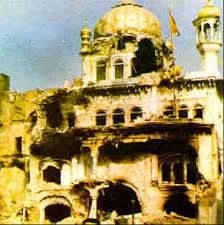
5. Just to explain in short the geographical structure, so readers can comprehend the picture clearly in their minds. Within the vast complex of Harminder Sahib (Also called the Golden Temple to signify the Gold domes) consist of two major building structures- The main Gurdwara (place of worship) with the gold domes, as popularly seen in pictures on Google, represents the concept of ‘Piri’ – the spiritual aspect of life. The opposite side stands the building structure called the ‘Akal Takht’, representing the concept of ‘Miri’ – The temporal power. Hence, for a Sikh, the balance between ‘Miri’ and ‘Piri’ completes a life with moral standards being the foundations for both aspects.
Ever since the construction of Akal Takht under the inspiration of the sixth Guru, Guru Hargobind Singh ji, it has remained the highest seat to signify the temporal or political strength for the Sikhs. It democratically appoints the chief leader, and his order is the final word in socio-political matters, affecting the Sikhs. The then chief leader of Akal Takht wrote a letter condemning the deplorable actions of the Indian Army, and warned the authorities that unprovoked attacks on the civilians and Sikh leaders should be stopped, or Sikhs would have no alternative but to retaliate.
As said before, the Government ignored all appeals in their short-sightedness. Indra Gandhi was known for her dictatorial mindset even by the Hindus, and like any dictator and narcissist, she had grown too overconfident for her own good.
Hence, enough warnings, appeals, and common-sense messages were sent to the army chiefs and the Government officials. Sikhs awaited orders from General Shabeg Singh ji and Sant ji.
Just a few words on General Shabeg Singh – He was the most decorated General in the Indian Army, a real asset for the Indian forces with unparalleled achievements on the battlefields. However, Indira Gandhi wanted to use him as her personal henchman against the political opposition, which Shabeg Singh refused. The egocentric Prime Minister took his disobedience very personally. Consequently, Shabeg Singh was court-martialled on petty accusations which could never be proved, but a dictator is all in one- Judge, jury, and executioner. Shabeg Singh was released without a pension. These were the circumstances in which he joined Sant Ji and started to realise that the injustice against the Sikhs went much deeper. Loss to the army was a gain for the Sikhs, especially in the most decisive battle that was to inspire the struggle of the Sikhs for generations.
The 3rd of June 1984
Many spies were sent inside the complex to gather information about locations, numbers, and the extent of ammunition with the Sikh fighters. Shabeg Singh had already briefed the Singhs that the most effective weapon which the Sikh fighters had was the ‘information.’ Where the Indian Army had shown their card, unintentionally, to give a clear idea about the weapons they would use and how many battalions were deployed to attack them, they knew nothing about how prepared the Sikhs were.
In the immortal message by the courageous General to his handful of amateur army, Shabeg Singh said, ‘The Indian army does not know that each one of us is fighting till death,’ as they were expecting the Sikh activists to raise their hands in the air and surrender out of fear. This was the weapon of mass destruction, metaphorically. The General utilised the courage of the Sikhs strategically, who were ready to fight with limited resources but inexhaustible determination.
Thanks to the foresight of our Gurus and the concept of ‘Miri,’ that the initiated Sikhs carry swords, as part of their Khalsa (the pure) Bana- the Sikhi robe. Sant Bhinderawale had sensed the intentions of the Government, and he had started preparing the Sikhs to fight both the psychological battle and the battle with arms. A few of the initiated Sikh activists had licensed pistols. Of course, swords were no match in the warfare of rockets and tanks, but the Sikhs would take the weapons of the fallen Indian soldiers and use them on their own army.
The tactic applied was not to shoot till the enemy was close, so that the attack was effective and useful in acquiring the weapons. Also, this would not divulge their location easily. It caused confusion amongst the army and the authorities about the preparation of the activists. Many of the foot soldiers refused to enter the premises out of fear of a fatal attack, as is told by a few honest surviving soldiers. I’ve already said before that a war is fought more with courage than with weapons, and on top of it, if the battle strategists are the legendary army General on one side, and a fearless Saint-Soldier on the other side, victory is the only possible outcome.
My expertise is limited for technical war analysis, so I shall conclude the day three of the battle here.
For additional information on the current state of Sikh affairs around the world and the Transnational repression sponsored by India, please connect with the link below:
 Universal Spirituality In A Sikh Spirit
As I read you, I clearly see how tremendous the misinformation from India was. They adapted events to suit their convenience in order to cover up the Sikh genocide. Your blog is truly an edifying read.
LikeLiked by 1 person
I have no words to appreciate your resonating understanding of the Sikh issues, especially being a non-Sikh. My head bows in gratitude 🙏🙏
LikeLiked by 1 person
You write with great conviction, and I’m interested in your story. Have a good night.
LikeLike
Really appreciate your motivational feedback. I wish only the best to always adorn your life. 🙏🙏
LikeLiked by 1 person
This is educational for me. The way the Indian government meant to wipe out the Sikh population disgusts me. I hope and pray things are as good for you Sikhs as they can possibly be, Jasleen. 💖🙏
LikeLike
Only a compassionate and humane heart can feel pain of other fellow human beings. So, my heartfelt respect for your kindness. Gratitude 🙏🙏🧡
LikeLiked by 1 person
Bhainji Waheguru ji ka Khalsa, Waheguru ji ki fateh parwan howe ji!
Itâs knowledgeable and eye opener article. You are doing great work for the Sikh Qaum.
Surinder Singh
CEO, Satluj TV
http://www.SatlujNetwork.com
[Text Description automatically generated]
This message contains confidential information and intended only for the individual named recipients. If you are not the named addressee you should not disseminate, distribute, or copy this email. Please notify the sender immediately by email if you have received this email by mistake and delete this email from your system.
LikeLike
Waheguru ji Ka Khalsa, Waheguru ji Ki Fateh, Surinder veer Ji and the entire Satluj tv team.
In my voyage to learn about Sikhi, Satluj tv, especially your podcasts have played a vital role. So, gratitude is mine to you.🙏🙏🙏
I am glad that you liked the article; it means a lot, especially coming from a learned active Khalistani brother. 🙏🙏
May Waheguru ji bless you and the entire Khalistani family with chadhdi kala.🙏🙏
LikeLiked by 1 person
Very interesting! I didn’t know anything about this! So thankful for your insight 🙏🏽🙏🏽🙏🏽
LikeLiked by 2 people
Thank you so much for your receptive comments. Gratitude. Its only by sharing that we all connect, beyond the boundaries and diversities. Stay blessed. 🙏🙏☺
LikeLiked by 1 person