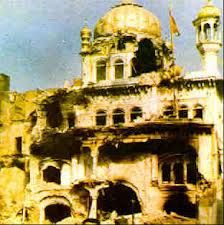
In my blog, I have introduced a few grains of Sikh history and culture as a taster for those readers who knew from nothing to a little about Sikhism, priorly. Although Sikh history is so extensive and deep, that it’s impossible to summarise it in mere blog posts. Volumes of literature have been written and still leave curiosity open to know more. In the next six articles, I shall endeavour to give my perspective on the most determining chapter in the history of the Sikh struggle against Hindu Tavi hatred, based on Sikh belief and their culture.
I’ll write one post daily to cover the martyrdom period between June 1st to June 6th, 1984, which spearheaded the current Sikh struggle for self-determination.
A flash course on Sikh-Hindu breakdown
The very first Guru of the Sikhs, Guru Nanak, had declared that he was neither Hindu nor Muslim. His philosophy which advocated spirituality in balance with worldly morality (Further reference : previous articles on ‘Miri and Piri’), was a contrast to the divisive and oppressive social inequality enforced by Hindutva ideology. It also challenged the tyrannical Mughal regime terrorising the masses, especially with forceful conversion of faith.
‘Sikhs are not Hindus was thus established quite clearly,’ which the Hindu regimes since have not been able to accept. While other minority faiths have either lost the will to fight back or somewhat accepted the majoritarian might, Sikhs have never ceased to stand up to the injustices. So, they have been the mighty thorns in their side, for over five hundred years.
Mughals demised and eventually British left post World War 2, but handed over on the plate the forcefully bonded 562 princely states which were previously independent nations; this included the vastest area of the Sikh kingdom famously ruled by Maharaja Ranjit Singh, which included Greater Kashmir, the present day Pakistan, Present day Afghanistan, parts of the present day Tibet, Nepal, and much of Delhi as existed then; Punjab remained the focus of his rule due to Sikh Guru’s history on this land.
Sikh kingdom was the last area that the British conquered in that region, but not before two fierce battles were fought and after Ranjit Singh’s conspired the killing, by administering mercury, just like in the case of Napoleon, as is strongly suggested in history. Thus started the new era of contention between the Hindu Tavi ideology and the Sikh pillars.
Despite the fundamental differences, the Sikhs have tried to make this relationship work at the socio-political level. It could be the highest representation in the Indian Forces despite being less than 2% of the total population, or succeeding in administration and excelling in business, and above all, leading in selfless service towards humanity, be it natural disasters or epidemics like Covid. Nevertheless, the Hindu regimes since the transfer of power in 1947, refused to recognise sikh contributions or even accept them as equal citizens. The attitude of Indian law and order proves the point, where hundreds of innocent Sikhs have been imprisoned, tortured, and killed in fake encounters. Those who have even completed their sentences following false convictions remain in police custody for further decades. In civilised countries this might be deemed to be illegal, but not in India.
As described many times before in my writings, Sikhs are the most patient and forgiving community but no one should try their calm nature; there are many movements of water before a tsunami rises.
Hopefully, this background will set the tone for the rest of the article.
The pivotal point, drawing the line
The water came to its first boil when a sect called Nirankari accelerated their anti-Sikh activities by publicising derogatory and provocative slogans against the Sikh Gurus. In 1978, when the notorious propaganda became vociferous and Nirankari group congregated in a pompous ceremony deliberately on the most auspicious day of 13th April when all Sikhs celebrate Vaisakhi- the day of formalising of Khalsa through initiation, when Sikhs were initiated as a community in 1699 (Ref: Previous articles on Vaisakhi).
The leader of the Nirankari sect also chose the most sacred place for the Sikhs- near Harmander Sahib (Also called the Golden Temple) in Amritsar to set up the provocative congregation, to instigate and aggravate the Sikh community. This was a planned conspiracy by the Indian deep state. Despite the blatant incitement, the Sikhs decided to handle the situation in a calm- and -collective manner and led a peaceful protest towards the congregation. The aim was to request a face-to-face discussion about the issues to come to an acceptable resolution. Instead, the cult leader ordered the opening of fire on the protesters which killed thirteen Sikhs. Many eye-witnesses also confirmed that even the Indian police joined in shooting at the Sikh protesters. This was the turning point in the Sikh struggle. Just to add, Nirankari ideology originally branched from Sikhism as a reform movement in 1883, but began to drift away from 1943 onwards under the influence of Hindu Tavi doctrine, and enough historic indications exist to endorse that the Congress party and its leaders like Jawahar Lal Nehru acted as patron of the group, licensed to carry out anti-Sikh propaganda. The trend continued since the 1940s. No wonder, that the Nirankari killers were acquitted in the Indian court, and the 1978 attack made the Sikhs realise that the possibility for justice exists only through fighting for their rights.
There have been many sects created by the Hindu Tavi government to keep the Sikhs aggravated since 1947. But I’ll leave the topic for another time.
So, this was the poisonous atmosphere Sikhs were subjected to breathe in under the so-called democracy. The brightest silver lining amongst these dark clouds was the emergence of a great leader for the Sikhs- Sant Bhindranwale led the community through the most difficult times and left an immortal inspiration for the Sikhs through his selfless service and martyrdom. He deserves a dedicated post, so for later.
The first day of the battle- June 1st, 1984
From as early as February to May in1984, the CRPF and the BSF forces of India began to siege Punjab state, especially Amritsar where the holiest spiritual seat of the Sikhs stands- The ‘Harmandar Sahib’ (Golden temple). This was a pre-meditated action planned to execute the genocide of the Sikhs. Foreign nations, like the UK under Margret Thatcher, and Israel Security Services, assisted India with planning, training, consultations and weapons for the heinous crime to be committed, but of course, it was all part of ‘diplomacy,’ political alliance, inter-state cooperation, and above all- trade deal of weapons. Isn’t the same happening today around us? Unfortunately, yes, while we all go about doing our daily business, just as it happened in 1984.
The official reason given by the government was to capture Sikh leader and activist, Sant (saint) Bhindranwale ji and his followers. (Ref: Previous posts). However, in reality, neither he nor his followers were even inside the Golden Temple complex at the time. The day chosen by the then Prime Minister, Indira Gandhi, was the martyrdom anniversary of the fifth Sikh Guru, Guru Arjan ji. The Government knew there would be thousands of pilgrims paying homage on the day, including babies and children. Also, June is the hottest month in India, and so the weather too was used as a weapon, especially when water and electricity were cut off inside the complex.
Sant Bhindranwale ji was in a nearby building at this moment, but when he was informed of the sinister intentions of the regime, he decided to enter the premises with his followers.
I would urge the readers to also refer to my previous post in which I described the ‘Miri-Piri’ concept in Sikhism to define the spiritual power and worldly power in balance with morality and justice for all; please also read the definition of ‘Sant-Sapahi (A saint soldier) who must stand and fight for truth and justice, even if it means the ultimate sacrifice- the martyrdom.
The evidence of the Government’s un-provoked aggression exists on record, when a few journalists, including a German lady reporter, tried to enter the premises to speak with Sant ji, but the German reporter was threatened with a loaded pistol by an Indian army soldier.
Bhindranwale ji urged his followers to stay peaceful and that no one shall respond till the attack started from the other side. The Special focus was on the safety of the pilgrims. But soon the agitated Indian forces were getting impatient with no action from the Sikhs despite the provocation. So, they began to shoot at the structures around the main ‘Gurdwara.’ This was followed by thirty rounds fired at the ‘Golden Temple’ structure itself. At this point, Sant Bhinderawale ji moved into the opposite building within the same complex, called the ‘Akal Takht’ which is the seat of temporal power for the Sikhs. Akal means God is timeless, and takht means the throne. This move was strategic in line with the Sikh principles.
One of the most decorated Indian Army General, Shabeg Singh ji, had already joined the Sikh mission after learning the deviousness of Indira Gandhi’s plans against the Sikhs. A meeting was called with the Sikh activists and it was unanimously decided that no one would open fire first and retaliate only if the army’s action caused loss of life, especially of a pilgrim.
I’ve referred previously to Sikh belief in never to attack first but to do all in self-defence.
Efforts were made to connect with the office of the then Indian President who was also a Sikh by image, which of course in reality was an eye wash. The effort proved futile because the calls were intercepted.
The unprovoked firing opened again by the forces, killing eight people, including a Sikh activist soldier.
Sant ji was now in the mode of a ‘Sant-Sipayee’ (saint-warrior)- the moment of reckoning had arrived –
‘Jabe baan lageyo’- when the arrow pierces
‘Tabhe ros jaageyo’- Only then does the righteous anger awakens.
The tenth Guru, Guru Gobind Singh ji uttered these words in the battlefield of Bhangani, fought against the atrocities of Hindu Tavi Rajas in North India in 1686.
At the end of day one of the imbalanced battle between the three infantry divisions of the Indian army and less than two hundred Sikh activists, out of which barely a hundred had any weapons on them. So, for the Sikhs, it was more a battle of strategy and courage, rather than sophistication of weaponry.
The firing lasted for seven hours. Several pilgrims were injured and seven killed, as the army was aiming at people, knowing they were all visiting worshippers. Babies too were not spared. Army fighting with civilians of own country as if attacking another nation is that shameful chapter in the Indian history which any amount of deceptive cover-up cannot erase.
The excuse given to the world and lapped up by the un-concerned global media, for the attack was to flush out the ‘militants,’ the ‘separatists,’ and the ‘terrorists’ from the place of worship. The action of the army against its own citizens proves who the real terrorist was, and the divisive hateful strategy of the Indian government is a testament to the real separatist agenda in the so-called democracy. Every person has the right to self-defence and the moral obligation to protect those who are vulnerable; in this sense, if the Sikhs are militants, then the title is earned by them proudly.
Sant Bhindranwale ji had predicted that ‘the day Indian army enters the complex of Harmandir Sahib, the foundation stone for an independent nation of Khalistan would be laid.’
The line of no return was thus drawn on the 1st of June 1984, and the struggle for self-determination commenced .
** I’ll continue with perspective on day two of the decisive battle tomorrow.
Please open the link below for further reference.**
 Universal Spirituality In A Sikh Spirit
In this part of the world (I live in Chile, South America), little is known about India, so the events of its internal struggles are off my radar. Therefore, the history of the Sikhs will fill a gap in my knowledge.
Your introduction to the subject is fascinating, and just like you describe it, I eagerly await the next chapters.
Manuel Calderón
LikeLike
First of all, my gratitude for taking time to comment on the post- Thank you for your kindness. 🙏🙏 Sikhs have been extending their selfless service for humanitarian causes, around the world, whether it is flooding in Spain or Pakistan, or service needed by the affected people due to war in Syria, or supplying free oxygen cylinder and shelter to the poor in India, etc. But Sikhs are too humble to advertise it; they just get on with it. I do feel that we live in a world of media and propaganda, so the Sikhs too need to tell the world of their humanitarian culture, without ego but with pride. Things are changing though, especially with social media. Thank you once again for your response and receptivity. Really appreciate it. Stay blessed. 🙏🙏🎉🎉
LikeLiked by 1 person
It’s a pleasure to read you, and I’m also gaining knowledge. I had no idea of the reach of your people and their importance to humanity.
LikeLike
Thank you for your kind words. Wherever the Sikhs have gone in the world, they respect the faith of others and abide by the law and order of the country. Despite being persecuted immorally in India, their mindset is not biased. That’s the reason that even when there have been any crisis even in India, Sikhs have been the first to come forward to help; majority of the recipients being Hindus since they are India’s majority population.
In every Gurdwara (sikh place of worship) in the world, there is free food served 7 days a week, irrespective of a person’s religious affiliation, colour, nationality, class, creed, or caste. To send of message of Oneness to all humanity, every Gurdwara was designed by our Gurus to have four doors to symbolise acceptance of all as One God’s children.
I can give thousands of examples of Sikh hospitality, valour, yet, humility, which I have tried to capture in my articles. I don’t write to propagate my faith, as undue influencing or enforcing your beliefs is not a Sikh philosophy. However, my motive is to share who and what Sikhs are because ‘sharing information’ can be a bridge to connect and connection is imperative to feel part of the Oneness of humanity, regardless of socio-political differences- some nature’s gift of diversity, but most created by manipulation to divide the mankind. So, I really appreciate your interest and receptivity as it’s a step towards the Oneness, in my eyes. Gratitude. 🙏🎉🎉❤
LikeLiked by 1 person
It’s comforting to know that you’re fighting for a just cause and you do it wonderfully well, with writing that’s rich in social and spiritual content. Good day to you.
LikeLiked by 1 person
🙏🙏🙏🙏🙏🎉🎉🎉🎉❤❤❤❤❤
LikeLiked by 1 person
Gracias Jasleen.
LikeLiked by 1 person
🙏🙏🎉❤
LikeLiked by 1 person
To me, it’s terrible for a religion to be warred against. I hope things are better for Sikhs these days.
LikeLike
My gratitude for your concern and wishes for the Sikh community. Things have deteriorated for the Sikhs, to the extent that self determination and freedom from Indian occupation of their land of Punjab is the only resolution. Sikhs are not ‘separating’ from India, as the Indian propaganda has been spreading, but want to ‘reclaim’ the land that was an independent state before the British haphazardly put all the 562 independent states under one umbrella of India, which was never a country before 1947- A well guarded secret.
May God bless the Sikhs with freedom that is every man’s and woman’s basic human right, even outside the religious structure. Thank you again for your kind comments. 🙏🙏
LikeLiked by 1 person
I’m ashamed to say that I was unaware of this instance. I’ve had the pleasure of encountering several Sikhs in my life, and have left every encounter with an impressive respect of the culture and person. I pray better circumstances come to the Sikh people.
–Scott
LikeLiked by 1 person
I am very grateful for your kindness. 🙏🙏🙏
You don’t have to feel guilty about not knowing the Sikh history in India. The World itself has been befooled by the tyrannical regimes under the guise of democracy for rather a long time. It is because where the national media was controlled by the dictatorial rulers, it also became the lens for the global view. Only what the Indian Governments decided to show to the world, has been seen, until recently. Thanks to the social media and diaspora Sikhs for showcasing the Sikh issues on the global stage, while fighting against all the odds for decades.
I am also glad that your experience with Sikhs has been positive. Hope every Sikh continues to represent the community in a positive way. Stay blessed. 🙏
LikeLiked by 1 person