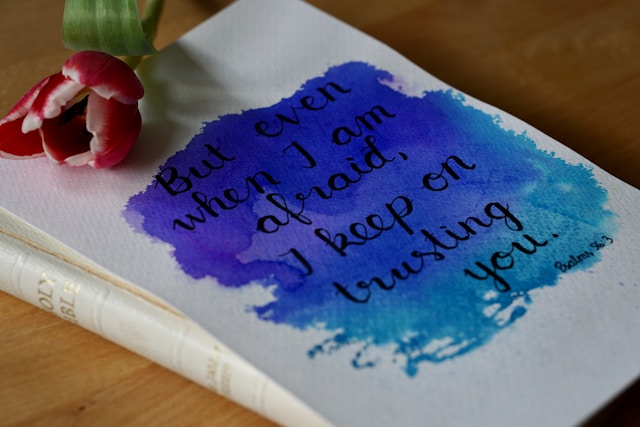

(To my readers: I have changed the title of the post to suit the subject matter better.)
I feel that belief, faith and trust are not interchangeable terms, but different stages between desire and destination.
A wish arises as a harmless hope, and gradually turns into a stubborn passion that one easily mistakes for a belief or faith…but deep down, trust is lacking in the dream itself, or one’s own capability to accomplish it. Just like a gambler – Hopes to win, and puts on a mask of false belief, but lacks the trust to win.
In all fields of life, from childhood to adulthood, we grow, hoping and wishing for various things, but we do not trust to achieve or get each one of them. However, the passion for the desire grows bigger and more intense, no matter what.
It reminds me of a favourite sport I loved to play in my childhood- flying kites with my brother. What an innocent, yet, a lethal game!
I remember both of us were red in the face and sweating more than a marathon runner, as the exercise of tugging created such tension and intensity since the focus was on cutting the string of other kites before someone else could slash through ours. The thought that your dear kite – your pride and joy, could spiral to the ground in a humiliating defeat is never acceptable, and you keep flying your kite higher and higher, while dodging all anti-kites, and getting more and more flushed, with sweat beads running down your spine, but you don’t care, as your only mission is to be the winner! So, the hope of flying the lovely colourful kite high in open skies changes to flying it ‘higher’ than other kites, it yet transforms further into a cut-throat competition of either cutting someone else’s kite or slashing your mighty string through the rivals’ kite. Before one realises, a game becomes a competition, and competition becomes animosity, and animosity becomes obsession. Obsseesive thought is often mistaken to be a belief ‘in self’ or a misplaced ‘self-confidence’.
You are truly blinded by the thought of victory, no matter how many kites you have to cut to the ground, while totally forgetting the main aim of the sport- ‘ To enjoy. To improve the dexterity of the mind. To participate and play together. To form a community of kite- flying- lovers. And to have fun, for God’s sake!’
We are taught to be on top of the class in school by our parents and teachers, and to succeed at the top in a career by the world. Most of us are guilty of following this hypnotic tune played by the materialistic world order.
We are given hope for making life better. Surely, this should have been a positive mission, but in our misguided and blind belief, without deeper understanding, the message loses its real meaning. We begin to hallucinate our success and mistake it for hope and optimism.
Imagine that hope for a healthy life begins with a stroll in the garden, collecting the fragrance of diverse colourful blooms, inhaling the freshness of green leaves from the tall trees, walking by the calmly flowing lakes, and listening to the soothing waterfalls.
After a while, the hope gets bored and believes that better peace and a healthier nature exist farther away. It begins to venture into forests, darker and denser, blindfolded with the mistaken belief of ‘even’ better and bigger adventures ahead.’ Hope is taken over by warped belief, and despite stumbling again and again, keeps walking into thicker and shadowier woods. The longer the belief walks in the dark, the more stubborn it gets to find light. Belief becomes ego now and shouts to your mind, ‘ I have faith in my own conviction, and I will prove to be right in the end.’ Deep down, there is no trust in having such a disposition, but belief is artificially formed without a clear vision.
Hope is hopeless if one can’t truthfully believe in it, and belief is merely an echo of the ego if one does not trust its foundations.
While hope and self-confidence are admirable traits of a human mind, reckless overconfidence is degenerative. This is what ‘Blind Belief or Blind Faith’ is. It exists in many forms, not just in religious or non-religious terms.
Again, faith is a positive term and a progressive mindset, but if planted in the wrong soil, it can grow to be ill-got credence in ‘self-cult’.
So, how to prevent the human mindset from misguided belief and self-delusion, yet promote hope and happiness?
As a trainer, I remember a classroom exercise of team-building. Every member of the group was blindfolded in turns and asked to either fall backwards or forward, expecting another team member to catch them before the fall. This was aimed at building trust in one another to build a strong collective team.
It would be particularly un-nerving if the exercise were to be introduced too soon in the class and before all delegates had familiarised themselves with one another. So, understanding of one another as colleagues and clarity of the aim of the lesson had to be established first.
Translating this into building a positive belief would mean that one needs to be familiar with one’s own thoughts and feelings first, then understand thoroughly as to what one wants/desires in life, making sure that the aim remains to better one’s life, regardless of what others desire or possess. Build the required skills to achieve your mission.
In a spiritual sense, it could mean practising meditation to build your inner spiritual self, and equally to grow a material yet moral desire.
An advanced stage of the classroom exercise was to let the blindfolded delegate decide which direction he/she would fall, and the rest of the group had to quickly anticipate the movement and be ready to catch and prevent the group member from falling. At this stage, the exercise was completed, solidarity was created, and trust was established. Result? The classroom learnt more, in a congenial atmosphere of mutual cooperation, even though each one had to perform individually to score a passing grade. Similarly, we are individuals with personal preferences, but the principle to build belief out of hope and trust out of belief, to accomplish the goal, remains the same.
To conclude:
When one says – ‘I wish I were rich’- But has no clue of why, and how, it is a blind hope.
When misguided affirmation prompts one to repeat this hopeless hope in the mind over and over again, it becomes a blind belief.
Whether in spiritual terms or materialistic terms, the act is nothing but befooling oneself.
When you feel, think, and then say, ‘ I trust I shall be rich.’ The statement now becomes a true conviction because one would only feel or think so if the probability factor has been tested, an action plan has been sorted, and the vision of the destination is clear.
So, work to reach the stage where instead of thinking, ‘ I hope, I wish, or I believe’, you begin to feel, ‘I trust.’
It’s now that your conviction is real, and there is nothing you can’t achieve.
I continue to work towards growing my belief into ‘trusting’ God, instead of stagnating at ‘believing’ in the Almighty.
I can now blindfold my efforts towards the clear vision, because I trust that the Higher-being shall catch me from every fall, as Nirankar has always done thus far.
Gratitude. 🙏
For me, as a Sikh, society, politics, and spirituality are all beads of the same rosary, if threaded in moral rectitude.
Hence, I attach another podcast by Angus Scott of ‘Satluj TV’, defining the example of a real Sikh, with trust in his moral conviction.
 Universal Spirituality In A Sikh Spirit
Fascinating memories of the competition you faced while kite flying, Jasleen. In my neighborhood, the main competition for boys was fist fighting.
LikeLike
Ha!Ha!My brother was black belt in judo, but I refrained from partaking that activity😊
LikeLiked by 2 people
I understand why you didn’t partake in that, Jasleen.
LikeLiked by 1 person
Well written…
LikeLiked by 1 person
Thank you for your kin words. 🙏🎉
LikeLiked by 1 person